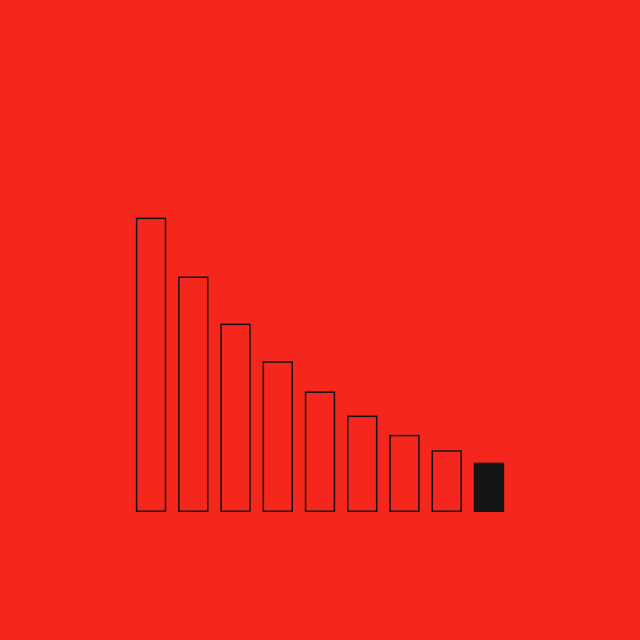

Involution describes competition that intensifies without producing any real gain. More effort goes in, output stays flat or even falls, and everyone involved works harder simply to hold the position they already had. The race consumes energy and returns nothing, and it can trap an entire industry for years.
The word has moved from academic writing into everyday speech, especially in China1, where it now names a specific and widely felt economic problem. Understanding it explains a great deal about why some of the country's most dynamic industries struggle to make money.
What involution means
The term was borrowed from anthropology2, where it originally described farming systems that absorbed more and more labor without raising output per worker. Applied to a modern economy, it captures the same futility: firms and workers pour in ever more effort to compete, and the extra effort cancels out.
It is distinct from healthy competition, which rewards the firm that finds a better way to do something. Involution rewards no one. It is a race in which every runner speeds up, the finish line moves back by the same amount, and the field ends up exhausted in the same order it started.
The Chinese context
In China the word jumped from campus slang to national conversation as it came to describe industries where firms cut prices below cost just to survive.3 A generation that had been promised that hard work led to advancement4 found the rungs of the ladder crowded and the rewards shrinking, and the term captured that frustration precisely.
Policymakers have begun to treat involution5 as a problem in its own right, warning against the kind of ruinous price wars that leave a whole sector unprofitable. Naming it was the first step toward arguing that some competition is worth discouraging.
Where it shows up
The pattern is clearest in the industries China dominates by volume. Solar panels, electric vehicles, and online retail6 all show dozens of companies fighting over the same shrinking margin, cutting prices faster than they can cut costs until almost none of them make money.
These are not failing industries in the ordinary sense. They produce enormous quantities of good products at falling prices, which looks like success from the outside. The trouble is that the producers themselves earn little or nothing, and the sector runs on investment that its own profits cannot justify.
The illusion of progress
Involution is dangerous precisely because it resembles progress. Prices fall for buyers, output rises, and the market looks vigorous. Underneath, producers are burning capital, wages stagnate, and the effort spent on competition is subtracted from the effort that might have gone into genuine improvement.
The gains are real but temporary, and they are paid for by the people inside the system. A market can look healthy right up to the point where the firms sustaining it can no longer afford to.
How it ends
Left alone, involution ends in consolidation. The weakest firms fail, the survivors absorb their share, and competition thins until the discipline that drove prices down is gone. The cheap prices that looked like a permanent gain can reverse once the field has been cleared.
The alternative is to break the cycle deliberately, through coordination, regulation, or a shift toward competing on quality rather than price. Neither path is easy, and both require admitting that more competition is not always better.